

 Français
2026-07-07
PEEK 3D printing: properties, applications and price
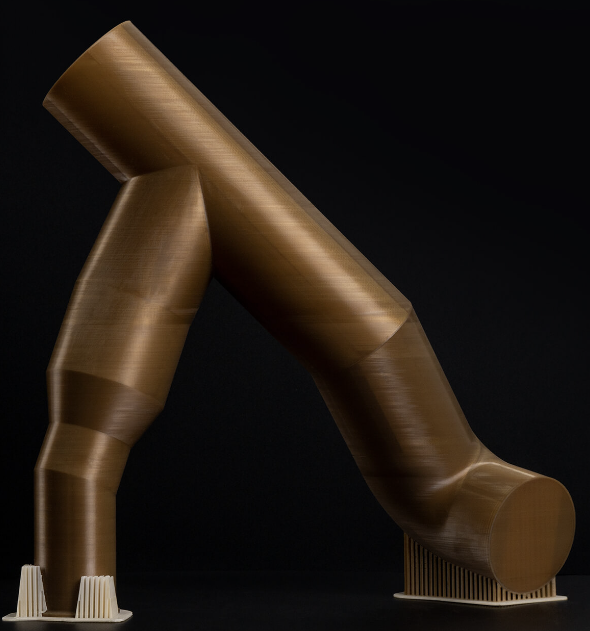
In short: PEEK is an engineering polymer that keeps its mechanical properties up to around 250 °C, resists chemicals and comes in biocompatible grades. It is 3D printed for demanding parts in aerospace, medicine and industry, where standard plastics would melt or creep. Printing it calls for specific machines and real mastery of annealing.
Printing PEEK, and its family of PEKK, ULTEM and PPSU, remains a niche skill: it takes specific machines and command of the process. This is where Symbio3D sets itself apart. This guide explains when PEEK is the right answer, its real properties, its applications, its printing requirements and its price.
What is PEEK?
PEEK (polyether ether ketone) is an engineering thermoplastic from the high-performance polymer family. It combines good temperature resistance, strong chemical resistance, solid mechanical properties and self-extinguishing behaviour. It also exists in biocompatible grades for medical use.
It is a semi-crystalline polymer: its internal structure partly reorganises into crystals as it cools, and that degree of crystallinity governs its final performance. This point comes back later, because it changes everything when printing.
It belongs to a family we print: PEEK, PEKK, PEI/ULTEM and PPSU. Each has its own territory. For an overview of the technologies, see our guide to which 3D printing technology to choose.
PEEK properties
| Property | Indicative value |
|---|---|
| Glass transition temperature (Tg) | ~143 °C |
| Continuous service temperature | ~250 °C |
| Melting temperature | ~340 to 350 °C |
| Tensile strength | ~90 to 100 MPa |
| Tensile modulus | 3.6 to 4.0 GPa |
| Chemical resistance | High (solvents, hydrocarbons) |
| Fire behaviour | Self-extinguishing (UL94 V-0) |
| Biocompatibility | Yes, depending on grade (implantable) |
Indicative values depending on grade, supplier and the degree of crystallinity achieved.
Why PEEK sometimes replaces metal
PEEK offers one of the best strength-to-weight ratios among plastics, which makes it a serious candidate for lightening parts previously made in aluminium or steel. At comparable mechanical performance in certain applications, a PEEK part weighs far less, is non-conductive, resists corrosion and damps vibration better.
Metal keeps the advantage in pure stiffness and absolute strength. PEEK becomes attractive when weight saving, electrical insulation, radiolucency or chemical resistance matter as much as strength.
PEEK, PEKK, ULTEM, PPSU: what are the differences?
These four polymers look alike from a distance, but each has a strength that decides its use. PEEK leads on temperature and chemical resistance, ULTEM stands out for its fire and smoke certifications, PPSU for its resistance to repeated sterilisation.
| Polymer | Continuous service | Main strength | Ideal for |
|---|---|---|---|
| PEEK | ~250 °C | Mechanical, chemical, biocompatible | Medical, industry, energy |
| PEKK | ~250 °C | Better printability, flame retardant | Aerospace, defence |
| ULTEM 9085 | ~170 °C | Fire and smoke certified (FST), light | Aerospace (cabin) |
| ULTEM 1010 | ~200 °C | High Tg (~217 °C), food contact | Industry, medical |
| PPSU | ~180 °C | Repeatedly sterilisable (autoclave) | Medical, instruments |
PEEK is semi-crystalline, ULTEM (PEI) is amorphous: that structural difference explains part of their behaviour. Indicative values.
See our service page on PEEK, PEKK, ULTEM and PPSU 3D printing and the high-temperature guide.
Applications by sector
In aerospace, ULTEM 9085 (fire and smoke certified) is used for cabin parts, ducts and brackets, while PEEK and PEKK go to structural elements and jigs. See our guide to 3D printing for aerospace.
In medicine, biocompatible PEEK equips instruments and implants, with the advantage of being radiolucent, and PPSU allows autoclavable parts. See our guide to 3D printing for medicine.
In industry and energy, PEEK is found on bushings, seals and pump parts exposed to heat and chemicals, notably in oil and gas. In automotive, it covers under-bonnet parts and high-temperature connectors.
Printing PEEK: the technical requirements
PEEK cannot be printed on a standard machine. Three conditions must be met, and a fourth comes after printing.
| Parameter | Indicative range | Purpose |
|---|---|---|
| Nozzle temperature | 360 to 440 °C | Melt the polymer properly |
| Heated bed | 130 to 160 °C | First-layer adhesion |
| Heated chamber | 90 to 160 °C | Prevent warping and delamination |
| Post-print annealing | slow ramp, 150 to 300 °C | Develop crystallinity and properties |
Indicative ranges, to be adapted to the grade and the machine.
The heated chamber is not a comfort but a necessity. Without it, adhesion between layers drops to 30–50 % of its value and warping goes through the roof. Annealing, for its part, takes crystallinity from its as-printed level (often 15 to 35 %) up to 35–45 %, which improves temperature resistance and stiffness. That level of demand explains why few workshops genuinely master these materials.
How much does a PEEK part cost?
PEEK is among the most expensive materials in 3D printing. The material cost alone sits at around 300 to 700 €/kg, where PLA runs at about 20 to 30 €/kg. On top of that come machine time (slow printing in a heated chamber), annealing and the quantity ordered.
| Material | Indicative material cost |
|---|---|
| PLA | ~20 to 30 €/kg |
| Nylon (PA) | ~40 to 70 €/kg |
| PEEK | ~300 to 700 €/kg |
Indicative raw material cost (2026 market), excluding machine, annealing and finishing.
Keep it for parts that genuinely justify its properties. If in doubt, describe your need (service temperature, loads, environment) and get an online quote: we will confirm whether PEEK is warranted or whether a cheaper material will do.
FAQ
PEEK or metal: when should you choose PEEK?
PEEK replaces metal to advantage when you are after weight saving, electrical insulation or chemical resistance. Metal remains stiffer and stronger in absolute terms.
Is PEEK biocompatible for an implant?
Yes, in its dedicated grades. It is also radiolucent, an asset in medical imaging.
PEEK or ULTEM: which should you choose?
PEEK for mechanical and chemical resistance and biocompatibility, with higher temperature resistance. ULTEM for aerospace (FST fire and smoke certification), good dimensional stability and a lower cost.
Why is annealing necessary?
It increases the crystallinity of PEEK, which improves its temperature resistance and stiffness. An unannealed part remains more heat-sensitive and less capable.
Can a part be made for food contact?
Yes, with certain grades such as ULTEM 1010 or PPSU. State the requirement in your request.
What are the lead times for a PEEK part?
Longer than for standard FDM, because of slow printing and annealing. The online quote gives an estimate matched to your part.
A project in PEEK, PEKK or ULTEM? Design your part online or get an instant quote. Our French team will advise you on the right polymer, under NDA.