

 Français
2026-07-06
Which 3D printing material should you choose? A complete guide
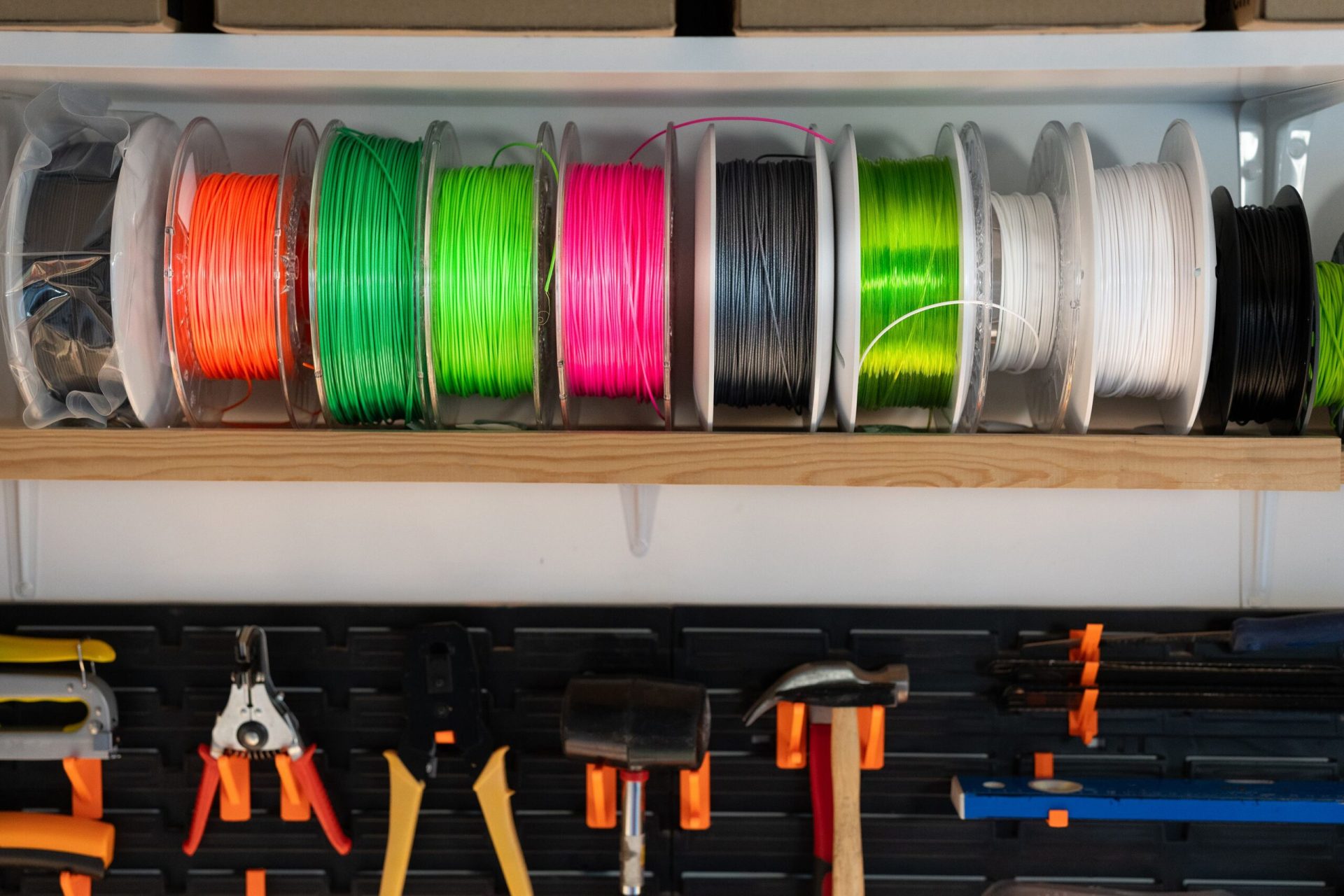
In short: The choice of material depends above all on what the part is for. PLA suits fast, economical prototyping, PETG and ABS suit technical parts, nylon suits mechanical work, resin suits fine detail, and PEEK or ULTEM suit extreme conditions. Four questions are enough to decide: strength, temperature, precision and budget.
With more than 50 materials available, the choice can look complicated. In practice, a few questions simplify it considerably. This guide reviews the main families, their real properties and how to match your part to the material that suits it.
The main material families
Everyday plastics (FDM)
PLA is the easiest to print and the most economical. Rigid but heat-sensitive (it starts to creep at around 55 °C), it suits visual prototyping and decorative work. It is also the most brittle: little elongation before breaking, so avoid it for a part that takes impacts.
PETG offers a good compromise between strength and ease of use. It handles moisture, impact and heat better than PLA, and some grades are food-contact approved. It is often the best starting point for a functional part.
ABS and ASA are more technical: resistant to impact and heat (around 100 °C), they call for a heated bed and an enclosed chamber to avoid warping. ASA adds good UV resistance, which makes it the choice for outdoor use.
Engineering and flexible materials
For mechanical work, nylon (PA) resists wear and fatigue, ideal for gears and hinges. PC (polycarbonate) adds strong thermal resistance (up to ~120 °C) and high impact strength. TPU is a flexible elastomer, for seals, dampers and parts that have to deform.
Fibre composites
By filling a nylon with carbon fibre (PA-CF) or glass fibre (PA-GF), you obtain parts that are far stiffer and more dimensionally stable. Carbon aims at maximum stiffness and lightness for structural parts (drones, brackets, tooling). Glass offers an attractive performance-to-price compromise, wears nozzles less and holds up slightly better under temperature. These materials are abrasive and require a hardened nozzle.
| Composite | Strength | Choose when |
|---|---|---|
| Nylon + carbon (PA-CF) | Maximum stiffness and lightness, creep resistance | Demanding structural parts (aerospace, automotive, tooling) |
| Nylon + glass (PA-GF) | Good performance-to-price ratio, less abrasive | Rigid parts without aiming at the top of the range |
Resins and high temperature
On the resin side (SLA), there are standard, tough, high-temperature and biocompatible ranges, all sought after for their fine detail and fine surface. For the harshest environments, engineering polymers such as PEEK, PEKK, ULTEM and PPSU take heat and chemicals in their stride, with biocompatibility possible depending on grade.
Property table
| Material | Technology | Tg (°C) | Strength | Ideal for |
|---|---|---|---|---|
| PLA | FDM | ~55 | Easy, economical | Prototypes, decorative work |
| PETG | FDM | ~80 | Versatile, robust | Functional parts |
| ABS/ASA | FDM | ~100 | Impact, heat, UV (ASA) | Technical, outdoor |
| Nylon (PA) | FDM | n/a | Wear, fatigue | Mechanical parts |
| PC | FDM | ~145 | Thermal resistance | Exposed parts |
| Resin | SLA | ~55-180 | Fine detail | Precision, appearance, casting |
| PEEK | HT | ~143 | Mechanical, chemical, biocompatible | Aerospace, medical, industry |
Indicative values depending on grade and supplier.
How to choose, in four questions
The simplest method is to describe what the part actually does, then answer four questions in order.
- Does the part carry mechanical loads? If so, look towards nylon, PC, a fibre composite or PEEK depending on how severe they are.
- Is it exposed to heat? Up to 60 °C, PETG is enough. Around 100 °C, you need ABS, ASA or PC. Beyond that, high-temperature materials are unavoidable.
- Do you need fine detail or a fine finish? Resin (SLA) gives the cleanest surfaces.
- Is the budget tight? PLA and PETG cover most everyday needs at low cost.
| Your need | Recommended material |
|---|---|
| Visual prototype, tight budget | PLA or resin |
| Everyday functional part | PETG |
| Technical or outdoor part | ABS / ASA |
| Mechanical part, wear | Nylon or fibre composite |
| Flexible part, seal | TPU |
| Heat or chemicals | PEEK, PEKK or ULTEM |
To understand the technologies behind these materials, see our guide to which 3D printing technology to choose. And to prepare a production-ready file in the right material, see preparing a 3D file for printing.
FAQ
Which is the strongest material?
For extreme toughness with heat and chemicals, PEEK and ULTEM. For structural stiffness, a carbon-filled nylon composite. In everyday use, nylon and PC already perform very well.
Which material for an outdoor part?
ASA, which resists UV, or PETG for less demanding use. Avoid PLA, which degrades in sunlight and heat.
Which material for food contact?
Certain grades of PETG, plus ULTEM 1010 and PPSU at the top of the range. The process and the surface finish matter too, so state the requirement in your request.
PLA or PETG to start a functional part?
PETG in almost every case: it handles impact and heat better while remaining simple to print. Keep PLA for the purely visual prototype.
Do fibre composites need a special nozzle?
Yes. Carbon and glass fibres are abrasive and wear out standard nozzles. A hardened nozzle (hardened steel) is required.
Unsure about the material? Describe your part and what it is for, then get an online quote. Our French team will recommend the right material, from prototype to production run.