

 Français
 Deutsch
 Nederlands
 Español
7 Jul 2026
Medical 3D printing: biocompatibility and applications
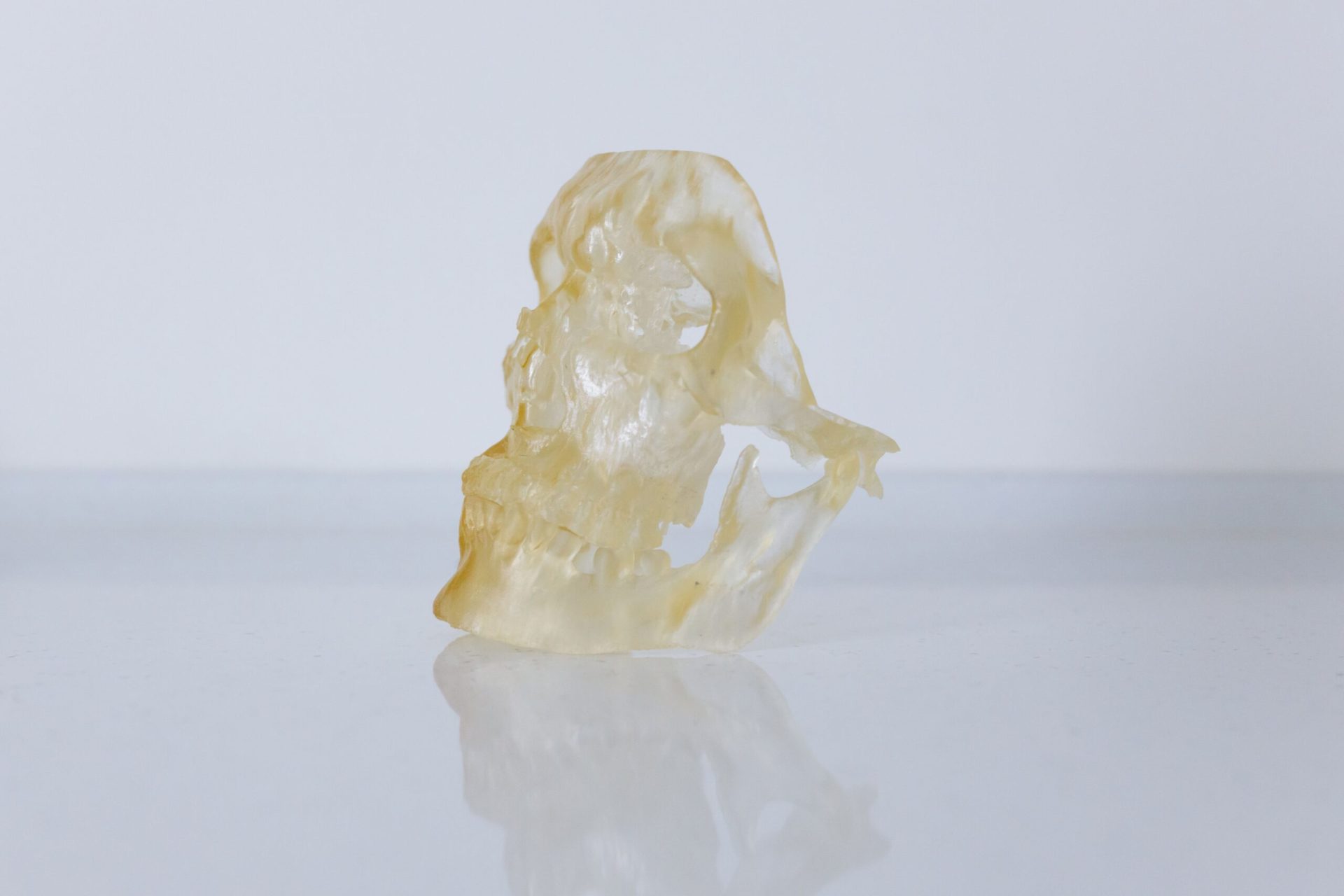
In short: 3D printing serves the medical field for manufacturing instruments, custom devices, anatomical models and sterilisable parts. The reference materials are biocompatible PEEK (instruments, implants depending on grade, radiolucent) and PPSU, which withstands repeated autoclave sterilisation. Biocompatible resins cover precision dentistry. Compliance always depends on the grade and on the regulations applicable to the device.
Medicine demands materials that are safe, precise and often sterilisable. 3D printing answers with biocompatible polymers and made-to-measure manufacturing, patient by patient. But you still have to choose the right grade and the right process, within a strict regulatory framework.
Why 3D printing in medicine
The value lies in three concrete uses. Personalisation first: devices are produced to match each patient's anatomy, from medical imaging — something a mass-production process cannot do. Sterilisation next: several printable polymers withstand the autoclave and repeated cycles. Finally, the absence of tooling makes one-off parts and prototypes quick to obtain, with no mould to pay for.
Biocompatibility, what it actually means
A "biocompatible" material is not a single box to tick: validation depends on the type of contact (skin, mucous membrane, blood, bone) and on its duration. Two standards come up repeatedly.
- ISO 10993 assesses biocompatibility through a series of tests (cytotoxicity, irritation, sensitisation, toxicity, according to use and contact duration). It is the most comprehensive framework, and the one most authorities rely on.
- USP Class VI is an older certification, centred on a few injection and implantation tests. It is often quoted, but is less exhaustive than ISO 10993.
For an implantable device, the grade must be certified and produced in a compliant environment (ISO 13485, for example). A "research" grade is not equivalent to an implantable grade. In practice, compliance is judged at the level of the material grade and of the finished device, not of the technology alone.
Medical materials
| Material | Medical strength | Typical applications |
|---|---|---|
| Biocompatible PEEK | Strength, autoclavable, radiolucent, implantable depending on grade | Instruments, implants, structural parts |
| PPSU (Radel) | Repeated steam, gamma and ethylene oxide sterilisation | Trays, reusable instruments, sterilisable parts |
| ULTEM (PEI) | High thermal resistance, sterilisable, contact depending on grade | Instruments, supports, jigs |
| Biocompatible resins (SLA) | Fine detail, grades certified according to use | Dental (aligners, surgical guides, models) |
Applications given as a guide. Compliance depends on the exact grade and on the regulations covering the device.
Biocompatible PEEK equips instruments and structural parts, with implantable use reserved for dedicated grades. Its radiolucency is useful in imaging. PPSU stands out for its stability across repeated sterilisation cycles. Biocompatible resins are used mainly for precision dentistry. To go further into these polymers, see our guides on PEEK 3D printing and high-temperature filament.
Sterilisation
The choice of material follows directly from the intended sterilisation method. The three common methods are not equally compatible with every polymer.
| Method | Principle | Suitable materials |
|---|---|---|
| Autoclave (steam) | Pressurised steam, 121 to 134 °C | PEEK, PPSU, ULTEM |
| Gamma rays | Irradiation, no heat | PPSU, PEEK, many polymers |
| Ethylene oxide (EtO) | Low-temperature gas | Heat-sensitive materials, PPSU |
PEEK and PPSU take repeated autoclave cycles (suppliers quote more than 1,000 cycles, an indicative figure). For a reusable instrument, that endurance points to these two polymers.
Typical applications
- Surgical instruments and sterilisable devices, in the appropriate grades.
- Custom cutting and drilling guides and jigs, aligned with the patient's anatomy from medical imaging.
- Anatomical models for preoperative planning and training, often in resin or in an economical material.
- Custom prostheses and orthoses, fitted to the patient.
- Precision dentistry in resin (aligners, surgical guides, working models).
Implantable uses do exist, but remain governed by medical device regulations and reserved for grades and processes qualified for that purpose.
FAQ
Are the parts biocompatible?
With dedicated grades, such as implantable PEEK or certified resins, yes. Compliance depends on the type of contact, its duration and the regulations covering the device. Tell us your intended use and we will point you to the right grade.
Can the parts be autoclaved?
Yes, with suitable materials such as PPSU, PEEK or ULTEM, designed to withstand repeated cycles at 121–134 °C. Standard PLA and PETG are not suitable for the autoclave.
What is the difference between a research grade and an implantable grade?
A research grade is for testing and validation without prolonged contact. An implantable grade is certified for use inside the body and produced in a qualified environment. The two are not interchangeable.
Do you manufacture certified medical devices?
We produce parts, prototypes and models in materials suited to medical use. Placing a medical device on the market falls under a specific regulatory framework, to be scoped project by project. To choose a material, see which 3D printing material to choose.
Is project confidentiality guaranteed?
Yes. We work under NDA, with manufacturing and data hosted in France.
A medical project? Get an online quote, under NDA. Our French team will help you choose the material, the grade and the process.