
 Français
 Deutsch
 Nederlands
 Español
7 Jul 2026
Small-batch 3D printing vs plastic injection moulding
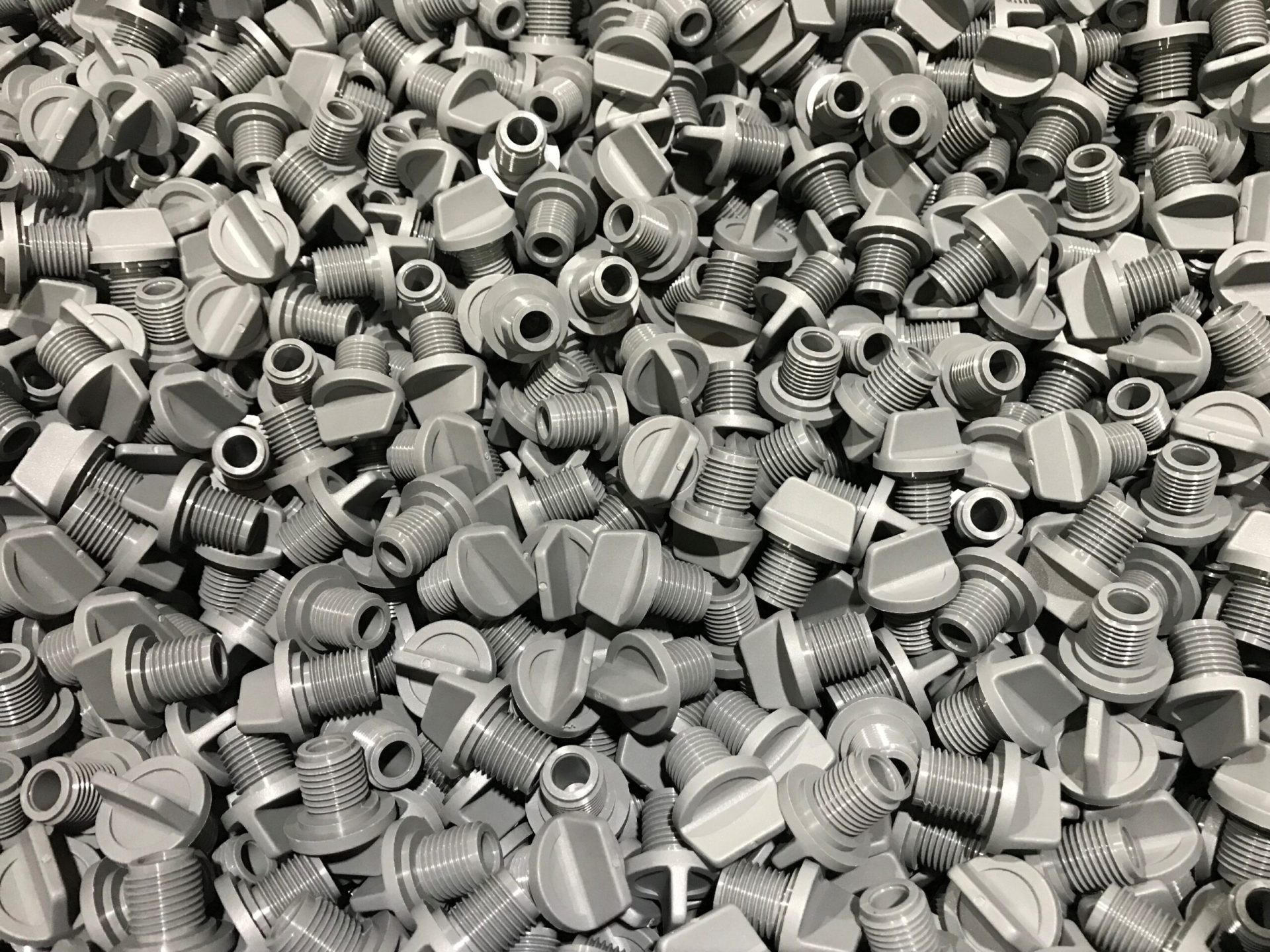
In short: For small and medium runs, 3D printing is often more cost-effective than plastic injection moulding: no mould to pay for, an immediate start and the freedom to change every part. Injection only regains the advantage at high volumes, when spreading the cost of the mould brings the unit price down. The switching point depends on the part, not on a universal figure.
Do you really need a mould costing several thousand euros to produce a few hundred parts? Often not. 3D printing changes the economics of small runs, and it also serves as a bridge to injection moulding when volumes eventually climb. What remains is to work out where your volume sits.
3D printing and injection moulding: two opposite cost logics
The two processes are not compared on the price of a single part, but on how that price behaves as volume grows.
Plastic injection moulding requires a mould, expensive and slow to make, costing anywhere from a few thousand to several tens of thousands of euros depending on complexity. Once that mould is paid for, each part costs very little. The unit cost therefore starts very high, then collapses as volume rises.
3D printing has no tooling cost. Each part costs roughly the same, from the first unit to the thousandth. No upfront investment, but no marked economy of scale either: the unit cost stays more or less flat.
| Criterion | 3D printing | Plastic injection moulding |
|---|---|---|
| Tooling cost | None | Mould: thousands to tens of thousands of € |
| Unit cost | Stable whatever the volume | Very low, but only once the mould is paid off |
| Time to start | Immediate, as soon as the file is approved | Several weeks (making the mould) |
| Changing the design | Free, you simply reprint | Expensive, sometimes a new mould |
| Customisation | Every part can differ | Identical parts |
| Cost-effective for | Small and medium runs | High volumes, frozen design |
The switching point depends on volume
There is a volume above which injection moulding becomes cheaper overall: the break-even point. Below it, 3D printing wins; above it, injection takes over, because the mould is spread across many parts.
Beware of off-the-shelf thresholds. Analyses often place that break-even point somewhere between a few hundred and several thousand parts, but it depends heavily on the size of the part, its complexity and the cost of the mould. A small, simple part switches early; a large, complex part with an expensive mould switches much later. The only reliable figure is the one calculated on your specific part. To understand what makes up that cost, see our guide on how much a 3D print costs.
The strengths of small-batch 3D printing
- No mould to pay for. Production starts as soon as the file is approved, with no upfront investment.
- Free to change. Correcting a part costs nothing, since there is no tooling to remake. Useful while the design is still moving.
- Customisation down to the single unit. Each part can vary at no extra cost, which opens the door to mass customisation.
- Production as needed. You manufacture on demand rather than holding stock — what we call inventory optimisation.
Bridge production, a route towards injection moulding
3D printing is not always the opposite of injection moulding: it can come before it. This is bridge production. You print the first hundreds or thousands of parts while the mould is being made, or for as long as demand is unconfirmed. That lets you serve a market straight away, validate the part in real conditions, then move to injection once the design is frozen and the volume secured. 3D printing also acts as a fallback if an injection line breaks down, or to produce spare parts on demand.
When to switch to injection moulding
Stay with 3D printing while any of these cases applies. Move to injection when the situation durably reverses.
| Stay with 3D printing if… | Switch to injection if… |
|---|---|
| Volume remains moderate | Volumes become high and regular |
| The design is still changing | The design is frozen |
| Each part is customised | All parts are identical |
| Demand is not yet confirmed | Demand is stable and predictable |
3D printing keeps all its value upstream: prototyping before injection, then producing the intermediate runs. For developing the part itself, see our guide to rapid prototyping.
FAQ
From how many parts does injection moulding become cost-effective?
It depends on size, complexity and the cost of the mould. 3D printing generally stays competitive up to a few hundred, sometimes a few thousand parts. The exact break-even point is calculated on your part.
Is the quality good enough for production?
Yes. With the right materials (nylon, PC, engineering polymers) and quality control, the parts are functional and durable.
Can prototyping and production be combined?
Absolutely. You validate the prototype, then move straight on to small-batch production without changing tools or waiting for a mould.
Can we produce with 3D printing while waiting for an injection mould?
Yes, that is bridge production. It lets you deliver immediately and secure demand before investing in tooling.
A production project? Get an online quote: we will compare 3D printing and injection moulding honestly for your case, volume in hand.