

 Français
 Deutsch
 Nederlands
 Español
6 Jul 2026
Which 3D printing technology should you choose? FDM, resin, HT
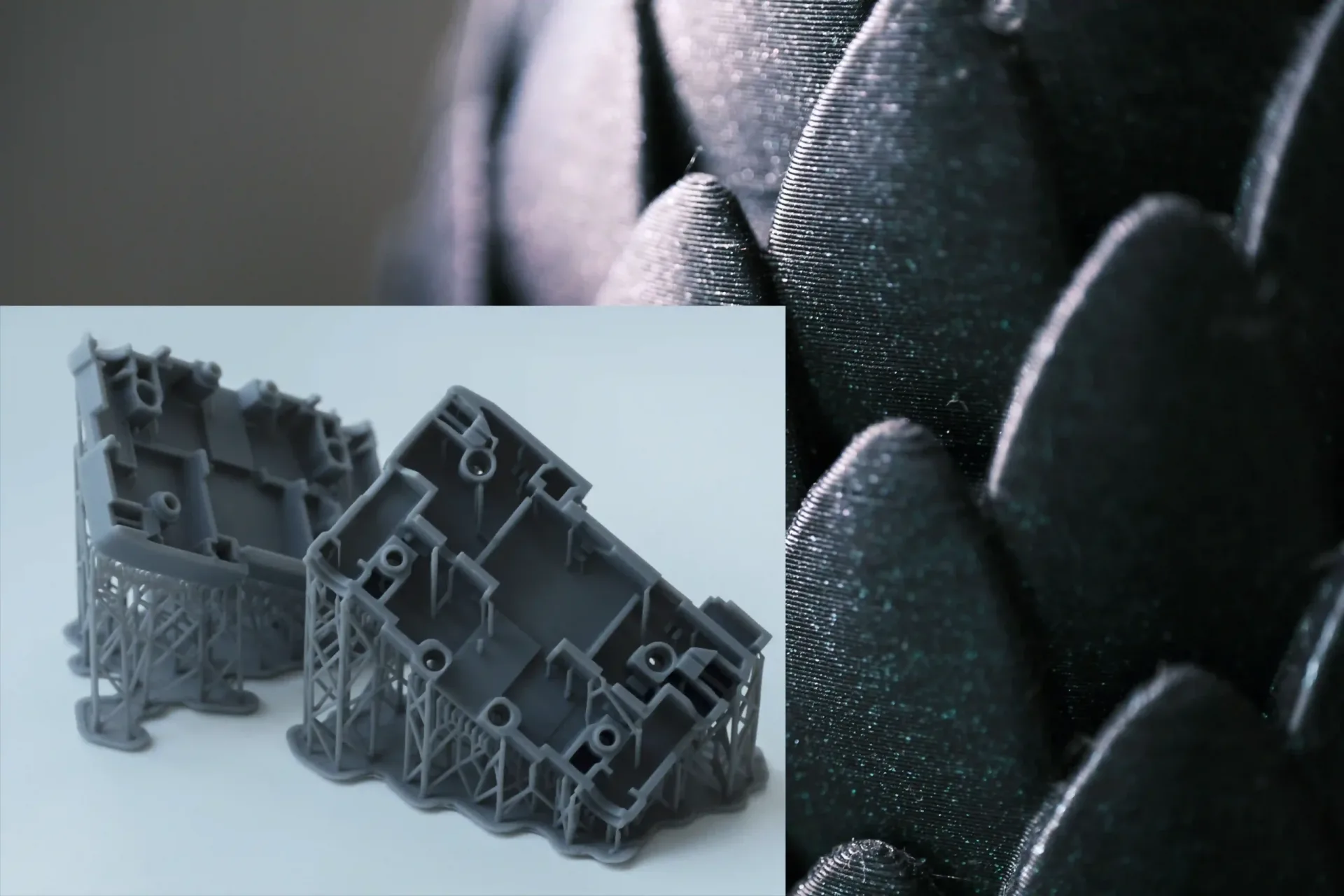
In short: For a functional, robust part on a controlled budget, FDM is enough in most cases. Resin (SLA) wins when you need fine detail and a fine surface. And as soon as there are heavy temperature or chemical constraints, you have to move to high-temperature filaments such as PEEK or ULTEM. Everything turns on what the part actually does.
Choosing the right 3D printing technology is already half the work. Whether you design in an engineering office or simply have a part to get made, this guide helps you decide according to your part, not according to the machine you might buy: at Symbio3D, we print for you.
The three main families
FDM (fused deposition modelling) lays down a molten plastic filament layer by layer. It is the most versatile and economical solution, from functional prototype to working part. It covers PLA, PETG, ABS and ASA, nylon (PA), PC, TPU and fibre composites. See our FDM 3D printing page.
Resin, or stereolithography (SLA), cures a liquid resin with a laser or UV light. Its layers go down to 30 microns, against 80 to 340 in FDM, which gives it the finest detail and smooth surfaces. The final result is similar to injection moulding. See our resin 3D printing page.
High-temperature filaments (PEEK, PEKK, PEI/ULTEM, PPSU) keep their properties beyond 150 to 250 °C, resist chemicals and are often self-extinguishing. This is where we differ: few workshops genuinely master these materials. See our high-temperature guide.
Comparing the technologies: the six criteria that matter
- Precision. Resin is clearly ahead of FDM and high temperature, with layers down to 30 microns.
- Surface finish. Resin comes out smooth and ready to use. FDM and high temperature leave layer lines, which post-processing softens.
- Mechanical strength. High temperature leads, ahead of FDM (nylon, PC); standard resin remains more brittle.
- Temperature resistance. High temperature reaches 250 °C, FDM holds between 50 and 105 °C, resin between 50 and 80 °C.
- Choice of materials. FDM offers the widest catalogue (more than 50 with us). Resin comes in specialised ranges, high temperature in engineering polymers.
- Cost and lead time. FDM remains the most affordable, resin sits in the middle, high temperature is the most expensive.
Comparison table
| Criterion | FDM | Resin (SLA) | High temperature |
|---|---|---|---|
| Precision / detail | Good | Excellent | Good |
| Surface finish | Layer lines | Smooth | Layer lines |
| Mechanical strength | Good to high | Moderate | Very high |
| Temperature resistance | 50-140 °C | 50-220 °C | up to 250 °C |
| Chemical resistance | Moderate | Low | High |
| Budget | € | €€ | €€€ |
| Ideal for | Functional parts | Precision, appearance | Aerospace, medical, industry |
(Indicative temperature resistance values (depending on material and post-processing). Contact us for a specific application.)
Which technology for your part?
If budget and robustness come first, go with FDM (PETG or ABS for technical work, nylon for mechanical parts). For fine detail or a fine finish, choose resin. We also have resins made for gear work. For heat, chemicals or severe constraints, you need PEEK, PEKK or ULTEM.
If you are torn between strength and precision, describe what the part actually does: its service temperature, the load it carries, the tolerances expected. That is what decides, and our team can point you in the right direction. Once the technology is chosen, remember to prepare your 3D file for printing properly, tolerances included.
Applications by sector
In aerospace, ULTEM 9085 (fire and smoke certified) is used for cabin parts, brackets and jigs. In medicine, biocompatible PEEK serves instruments and implants, and PPSU autoclavable parts. In industry and energy, high-temperature materials take heat and chemicals, while FDM covers tooling and jigs. In automotive, FDM goes to functional prototypes and high temperature to under-bonnet parts. In design, finally, resin gives the most detailed parts.
Post-processing and finishing
With FDM, you remove the supports, sand, smooth ABS with acetone vapour, and can paint. With resin, the part goes through an alcohol wash then UV post-curing, to be handled with care, before the supports are removed. With high temperature, post-print annealing develops crystallinity and mechanical properties.
How much does 3D printing cost?
The price depends on four things: the volume of material, machine time, the material (FDM is the cheapest, high temperature the most expensive) and the quantity, since the unit cost falls with volume. The simplest route is to upload your file for an instant quote.
FAQ
Which 3D technology is the most precise?
Resin (SLA), with layers down to 25 microns and smooth surfaces. It is the choice for parts with fine detail.
Which is the strongest?
High-temperature filaments (PEEK, ULTEM) for extreme constraints. For everyday use, nylon and PC in FDM are already very robust.
FDM or resin for a prototype?
FDM if the prototype has to be tested mechanically. Resin if it is mainly visual or calls for a lot of precision.
Which technology for a part that gets hot?
Beyond about 100 °C, aim for PC or high temperature. Beyond 150 °C, PEEK or ULTEM become unavoidable.
Can small runs be produced with 3D printing?
Yes, and it is often an economical alternative to injection moulding for small and medium volumes.
Is a food-contact or medical part possible?
Yes, with certain grades such as PETG, ULTEM 1010 or PPSU. State the requirement in your request.
Got a project in mind? Design your part online without CAD software, or get a quote. Our French team will advise you on the right material, from prototype to production run.